Preview
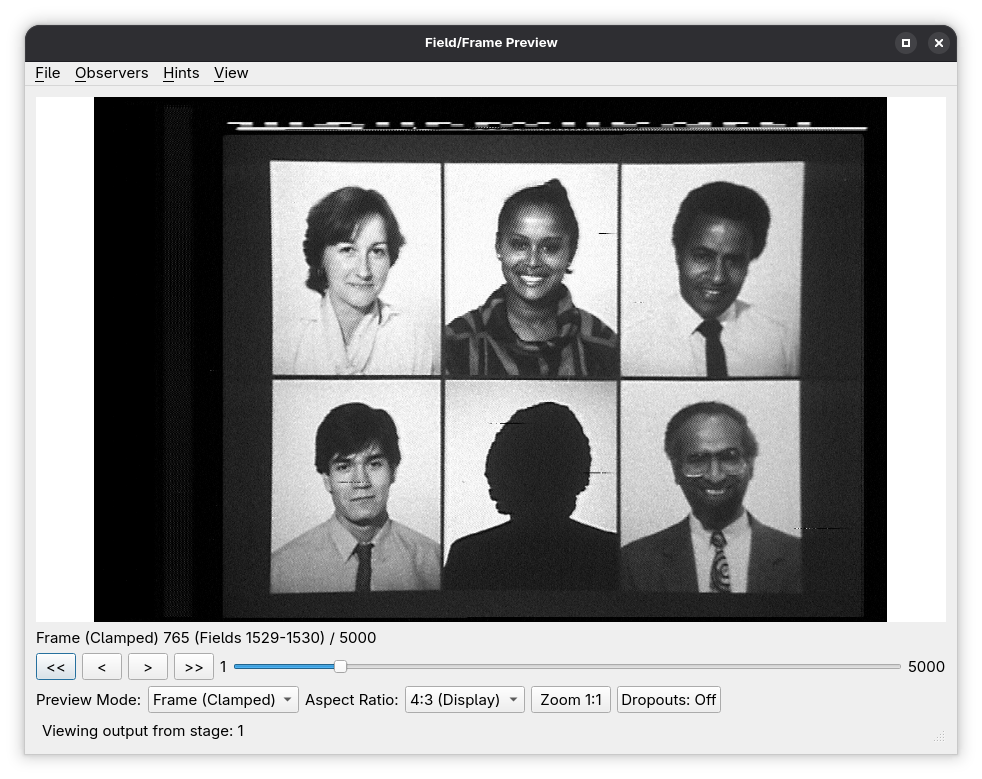
The Preview dialogue provides interactive visual inspection of data flowing through a decode-orc pipeline. It is not a stage itself, but a UI tool that can attach to any stage that exposes preview support.
Previewing is intended for validation, and tuning. It allows you to verify timing, field order, signal integrity, and the effects of transform stages before committing to final outputs.
Preview-capable stages
A stage supports preview if it implements the internal preview interface (commonly exposed in code as PreviewableStage). Most source stages, all transform stages, and some sinks support preview.
Preview support generally includes:
- Per-field image display
- Field stepping and scrubbing
- Parity (first/second field) indication
- Optional overlays generated by the stage
Core preview features
Field navigation
The preview dialogue allows navigation through the pipeline output one field at a time.
Supported controls include:
- Step forward / backward by field
- Jump to a specific field index
- Continuous playback (where supported)
Field indices always refer to the post-stage output, not the original source numbering.
Audio playback
When the previewed stage's output carries audio channel pairs, the preview dialogue offers an Audio selector listing them (plus Mute/None), together with a volume slider. Selecting a pair and pressing play sounds that pair alongside the advancing preview; choosing Mute/None silences it.
Playback is audio-mastered: the audio plays continuously at normal speed and the video chases it. Preview rendering cannot be relied on to reach real time — a 3D chroma decoder or a neural stage may need seconds per frame — so the preview shows whichever frame the audio has reached and skips the frames the renderer could not deliver in time. The sound is always continuous; on a heavy pipeline the picture simply refreshes at a lower rate.
Points to be aware of:
- Some sources decode their whole audio stream on first access (a TBC source, an imported WAV, or an EFM disc decode, which can take minutes). A progress window appears when the wait is long enough to notice, and the prepared audio is retained so that pausing and resuming is immediate. CVBS containers read audio per frame and need no preparation.
- Preparing audio for a TBC, imported or EFM source holds the decoded stream in memory, which can reach hundreds of megabytes on a feature-length title.
- Channel-pair numbering belongs to the stage's output, so the selector is re-read and reset to Mute/None whenever the previewed stage changes.
- Editing parameters or the graph invalidates the prepared audio and stops playback; press play again to restart.
- Scrubbing during playback restarts the audio from the new position.
- Choosing Mute/None during playback ends the audio session, so the preview reverts to its timer-paced video-only playback rather than chasing an audio clock. Picking a pair again resumes audio-mastered playback from the position reached.
- Projects with no audio are the normal case. The audio controls are then disabled and playback behaves exactly as it does without the feature.
Field parity display
The preview UI indicates whether the currently displayed field is:
- First field
- Second field
This is derived from the field parity hints carried through the pipeline and is especially useful when validating:
- Field order correctness
- Alignment after
source_align
Video scaling and rendering
Preview rendering uses decoded sample data and applies:
- Black and white levels (IRE-based)
- Active video region hints
- Aspect-correct scaling for display
This ensures the preview reflects how downstream sinks will interpret the signal.
Stage-specific preview behaviour
Some stages augment the preview dialogue with additional behaviour or controls.
Dropout-related stages
Stages such as dropout_map and dropout_correct may visually indicate dropout regions.
Examples include:
- Highlighted dropout areas
- White-filled correction regions (when enabled via parameters)
These overlays are generated by the stage and rendered by the preview UI.
Masking stages
For stages such as mask_line, the preview will show masked regions directly in the rendered image, allowing immediate verification of:
- Line selection
- Mask sample level
Parameter override stages
Stages such as video_params affect how the preview is rendered by changing:
- Active video boundaries
- Black and white levels
- Burst and active region hints
The preview dialogue always reflects the effective parameters after overrides, making it a reliable validation tool.
Preview limitations
- Preview is non-destructive and has no effect on pipeline output.
- Preview performance depends on stage complexity and pipeline position.
- Some sink stages may not support preview.
Typical preview workflows
Common uses of the preview dialogue include:
- Verifying capture integrity immediately after a source stage
- Checking alignment after
frame_mapandsource_align - Tuning
stackerparameters while observing dropout behaviour - Validating dropout correction before committing to final output
- Confirming active video and masking settings
Notes on preview usage
- Preview always shows the output of the selected stage.
- When multiple branches exist, each branch can be previewed independently.
- Preview does not bypass or alter pipeline execution.
The Preview dialogue is an essential companion to decode-orc’s stage-based design, providing immediate visual feedback for pipeline construction, debugging, and validation.